To learn how to train service dogs, you must have the right temperament, skills, and dedication. It is also important to have a knowledge of basic dog training skills which you can learn by taking our Dog Trainer Program. Service dog training goes far beyond basic obedience commands such as “Sit,”,”Stay,” and “Come.” You will be training dogs to exceed their natural instincts and abilities. ABC’s Service Dog Training Program provides you with the knowledge to train these special dogs to meet the many needs of their handlers and owners.
Our Service Dog Training Course emphasizes the need to understand dog behaviors and their motivations, as well as provide solutions using training techniques based on scientific research and experience. In addition to understanding the reasons underlying a dog’s behavior, service dog trainers must have a range of behavioral solutions at their disposal. We also provide you with the tools to become an effective communicator and teacher for both service dogs and service dog handler.
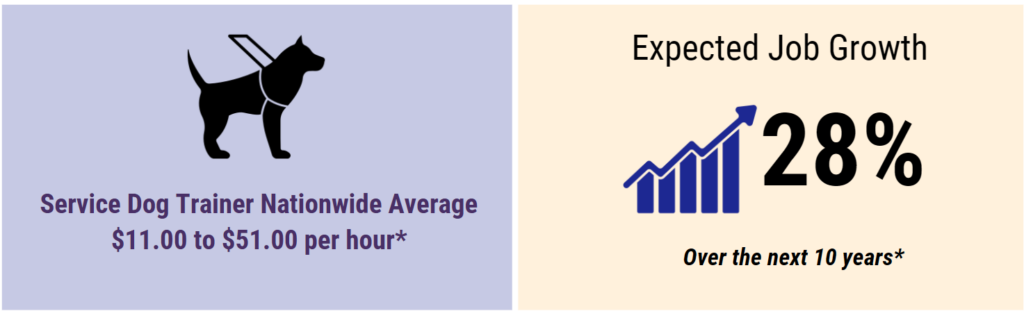
Service Dog Trainer Career Earning Potential
*Source: Bureau of Labor Statistics, ZipRecruiter & Zippia.com 2024. Hourly rates may vary in your area.
Online Service Dog Trainer Curriculum by Stage
Stage 1: Introduction to Service Dogs
Stage 1 answers the question: What is a service dog? We begin with the legal definitions and service dog training requirements in the United States and Canada, as well as in Great Britain and the European Union. Included in the discussion are explanations regarding documents required when traveling with a service dog. This information is vital to anyone training or handling a service dog.
This stage also provides information about different types of service dogs, with a focus on the types our program prepares you to train. You will also learn the difference between service dogs, therapy dogs and emotional support dogs. This stage concludes with an overview of the benefits an individual can experience through having a service dog.
Stage 2: Service Dog Candidate Selection
Service dogs play a vital role in serving and protecting the well-being of their human partners. They are represented by dogs of all sizes and many breeds, including mixed. Service dogs undergo extensive, individualized training and usually stay with their handler for years. It takes a special kind of dog and a special kind of trainer to create the ideal partnership between a service dog and her handler.
Selecting the “right” dog for service training is of utmost importance. Any service training candidate should be thoroughly evaluated and carefully chosen so that the odds of success are as favorable as possible. Stage 2 teaches you how to choose and assess service dogs, identifying the most likely candidate to fill your clients’ needs. This stage provides you with the process, pointing out specific traits to look for and those to avoid. It also discusses assessment products that may help you make a better selection. Selecting a puppy for service dog training is different from selecting an older dog or a previously owned dog. Evaluating a shelter dog has its own set of considerations. The risks and benefits of training each type of dog is covered.

Stage 3: Canine Health for Service Dogs
This stage was written by a veterinarian with service dog training experience since we understand that peak physical condition and sound behavioral health of a service dog are essential for an optimal human-dog partnership. A relatively minor issue can affect a service dog’s ability to achieve maximum potential. Minor health issues can become more problematic over time. Chronic or ongoing health conditions drain a dog’s mental and physical energy and may be mistakenly identified as a behavioral or training issue.
Highly trained service dogs often ignore pain or other physical ailments to perform their duties. This tendency makes it even more important for service dog trainers to be knowledgeable and vigilant when it comes to their dog’s health. A skilled and experienced veterinarian is vital to ensuring canine health, but nothing is more valuable than an owner or trainer who carefully observes and understands their service dog and is able to detect subtle changes and address them before they become more serious health issues.
In this stage, you will learn about the routine and preventative care measures every dog owner should observe. Emergency medicine is also covered, including a detailed list of the first aid items you should always have on hand. You will also learn how to check for signs of illness or injury and how to identify signs of stress that can affect a dog’s health and performance.
Stage 4 : Living with a Service Dog
This stage discusses the differences between training a pet dog and training a prospective service dog. It addresses the training beliefs and rules that are challenged by service dog training. It explains how to skillfully apply learning theory to develop desired behaviors and strategies to prevent or minimize undesired behaviors.
Service dog training teams coexist in a partnership in which the human is not attempting to assume the role of “pack leader.” Typical household rules are fluid or nonexistent. Instead of attempting to assert control over a service dog prospect, we focus on training desired behaviors. Service dog prospects have a myriad of skills to learn, and because they spend so much time training, it is reasonable to prevent or effectively extinguish undesired behaviors by replacing them with manners and routines that are covered in this stage. Service dog prospects must master these skills to live safely with handlers of differing abilities.
Stage 5: Obedience and Maneuvers
Obedience and maneuvers prepare a dog to be a well-mannered companion, an effective service dog and an unobtrusive partner in public-access environments. Tasks created from obedience and maneuvers, such as blocking, bracing and harness pull tasks are taught. Also covered in this stage are basic positions and movements, and how to use them to develop appropriate behavior in public settings.
Handlers begin training in public access environments with the goal of passing a public access test when their dog is over a year old. Expectations for handler and dog behavior when training in public access environments are discussed. Common exercises on public access tests and how to administer public access tests are also included.
Stage 6 : Task Foundations, Behavior Chains and Behavior Sequences
Trainers use obedience skills combined with task foundation skills to chain the task behavior(s) the client needs the dog to perform. While task training involves teaching dogs complex behaviors, it’s often thought of as the easy part of service dog training.
In this stage, you learn to teach service dog tasks most efficiently by training foundational behaviors, or chunks, and then chaining them into sequences of behaviors that prevent or reduce a handler’s disabling symptoms. Some tasks become most beneficial to a handler when the handler’s response to their dog is incorporated as a Release.
Stage 7: Training Problems and Solutions
Many behavior problems in service dog training are caused by a dog’s difficulty coping with stressors. Some stressors are environmental, such as noise or weather. Some are physical-related, such as heat, chafing or thirst. And some are the result of training methods or trainer’s habits. Some stressors can cause long-term mental or physical health problems.
This stage reinforces your knowledge on how to recognize stress signals that predict problem behaviors and explains how to prevent and solve common training problems.
Stage 8: The Client
Stage 8 introduces you to best practices and how to interact with service dog training clients. As a service dog trainer, you will need to be adaptable and flexible. Understanding clients’ disabilities and their effects is crucial as your training plan will be built entirely around their needs.
This stage teaches you how to help a client determine which tasks might best prevent or relieve their disabling symptoms. You will learn a variety of ways for communicating with and motivating people, as well as how to manage effective training sessions.
Stage 9: Career Building
This stage provides you with everything you need to know to find a position with an assistance dog organization, such as how to write an effective résumé and cover letter, and how to have a successful interview. It also teaches you how to launch and run your own service dog training business. Starting with choosing a business name and creating a business plan, this stage goes into detail of how to market your service dog training business through networking online and with other pet professionals; how to create a compelling website through SEO best practices; how to use social media and traditional media to expand your customer reach; and how to market to specific demographics.
This stage also explains how to run your day-to-day business, including developing and adhering to a budget; creating contracts and forms; and delivering quality customer service. Career Building also covers how to expand your knowledge and skills through continuing education.
Stage 10: Final Exam and Graduation
Stage 10 is the Final Exam and your graduation. During this stage, you’ll be given a final exam which will test your overall knowledge of the service dog training education you have received. Upon passing, you will become an ABC Certified Service Dog Trainer (ABCSDT) and be invited to join the ABC Dog Trainer Alumni Group.
Short Term Programs
ABC offers Short Term Programs to those individuals interested in continuing their education. Although you may sign up for any of the Short Term Programs upon enrollment, you will only be granted access once you have successfully completed stage 3. This is done to ensure you have the knowledge necessary to maximize your learning experience. Check out all the Short Term Programs we offer here and increase the skills you can offer your new clients